The Search Monitor Competitors: Top Alternatives for Better Competitive Intelligence
Compare leading platforms for SEO, advertising intelligence, competitor research, and brand

Introduction
Businesses operating in competitive digital markets need more than basic keyword rankings. They need to understand what competitors are advertising, which keywords they target, how visible their brands are, and where opportunities exist across search results. This is where competitive intelligence platforms become valuable.
The Search Monitor is designed around search advertising intelligence, brand protection, compliance monitoring, SEO visibility, shopping results, and competitor analysis. Its current platform includes monitoring across paid and organic search, shopping, display advertising, and AI search visibility.
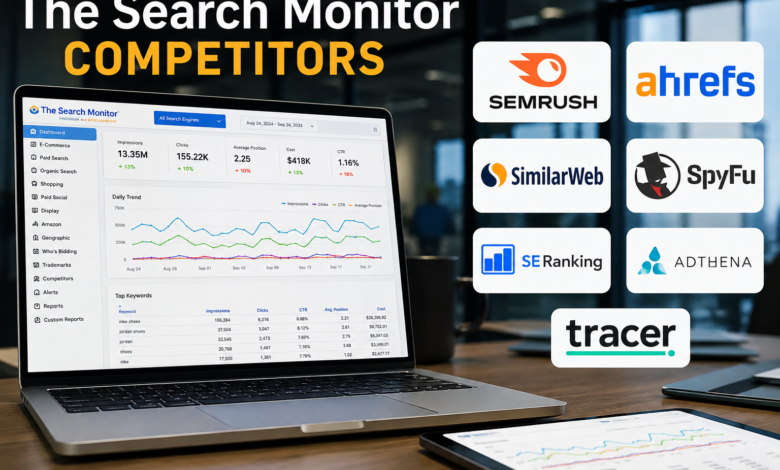
However, companies may look for The Search Monitor competitors when they need different features, pricing structures, reporting options, or a broader SEO toolkit. Several established platforms are frequently compared with The Search Monitor, including Semrush, Ahrefs, Similarweb, SpyFu, SE Ranking, Adthena, and Tracer.
What Is The Search Monitor?
The Search Monitor is a competitive intelligence and brand compliance platform that helps companies monitor search marketing activity.
Its capabilities include paid search intelligence, organic search monitoring, shopping analysis, competitor advertising research, affiliate compliance, trademark monitoring, and customizable reporting. The platform also supports geographic targeting, allowing businesses to monitor search activity by locations such as cities, states, countries, and other geographic areas.
One important feature is frequent monitoring. The company says its system can crawl search activity hourly and provide automated alerts when important market changes or potential violations are detected.
Why Businesses Look for The Search Monitor Competitors
There is no single reason to search for an alternative. Different businesses have different competitive intelligence requirements.
Some companies may want a complete SEO platform with keyword research, backlink analysis, technical SEO, and content tools. Others may prioritize paid-search intelligence, competitor advertising, brand protection, or AI-search monitoring.
The right choice therefore depends on the specific problem a business wants to solve.
Semrush as a Major Alternative
Semrush is one of the most frequently compared alternatives to The Search Monitor. G2 lists it among the leading alternatives and describes it as an online visibility and content marketing platform with competitive intelligence, SEO, local SEO, and paid-search capabilities.
Semrush can be particularly useful for organizations that want a broader SEO environment rather than focusing mainly on advertising compliance.
Businesses can use broader SEO capabilities to research competitors, examine keywords, investigate backlinks, evaluate websites, and develop search strategies.
For teams that want competitive research combined with a larger SEO workflow, Semrush can therefore be an important option to evaluate.
Ahrefs for SEO and Competitor Research
Ahrefs is another well-known alternative. It is particularly associated with SEO research, backlinks, organic search performance, and competitor analysis.
TrustRadius lists Ahrefs among the most commonly compared products with The Search Monitor and highlights its Site Explorer and competitor-analysis capabilities.
Ahrefs may be a strong fit for businesses whose main objective is improving organic search visibility rather than monitoring advertising compliance.
It can help SEO teams understand competitor websites, identify opportunities, and study the factors contributing to search visibility.
Similarweb for Digital Market Intelligence
Similarweb takes a broader digital-market approach. G2 identifies it as another major alternative to The Search Monitor and categorizes both platforms under competitive intelligence and paid-search intelligence.
Similarweb can be useful when a company wants a wider view of competitors and digital markets.
Rather than concentrating only on individual search advertisements, businesses may use broader digital intelligence to understand market trends, competitor activity, and online performance.
This makes it worth considering for larger organizations that need market-level information.
SpyFu for Competitor Search Research
SpyFu is another frequently mentioned competitor and alternative. G2 lists it among the alternatives to The Search Monitor and describes it as a platform for competitor analysis and research.
SpyFu can appeal to businesses that want to investigate competitor search strategies and identify opportunities in paid and organic search.
Its focus makes it particularly relevant for marketers who want competitive keyword and search advertising insights without necessarily requiring the complete compliance-monitoring environment offered by The Search Monitor.
SE Ranking for Broader SEO Workflows
SE Ranking is another alternative commonly compared with The Search Monitor. G2 describes it as an SEO toolkit covering keyword and competitive research, rank tracking, on-page and off-page optimization, content, technical SEO, and local SEO.
This broader feature set may make SE Ranking attractive to agencies and smaller in-house teams that want multiple SEO functions in one platform.
Its value is especially relevant when rank tracking and SEO management are higher priorities than trademark or affiliate compliance.
Adthena for Search Intelligence
Adthena is frequently identified as a competitor to The Search Monitor. CB Insights lists Adthena among the notable companies competing in this area.
Adthena focuses on search intelligence, making it relevant to organizations that want to understand competitive activity in search advertising.
For businesses heavily invested in paid search, comparing The Search Monitor with specialized search-intelligence platforms can help identify which system provides the data depth and reporting needed by their marketing teams.
Tracer for Brand Protection
Tracer is another company identified as a competitor to The Search Monitor. CB Insights lists Tracer among its top competitors.
Brand protection becomes particularly important for businesses whose names, products, trademarks, or digital assets are frequently targeted by unauthorized activity.
When evaluating a platform such as Tracer against The Search Monitor, businesses should focus on the exact type of brand threats they need to detect and how easily alerts can be turned into practical action.
The Search Monitor vs. Competitors
The biggest difference between these platforms is often their primary purpose.
The Search Monitor combines competitive search intelligence with compliance and brand-protection capabilities. Its official comparison page highlights competitive advertising insights, configurable geographic targeting, custom reporting, unlimited keyword packages, and trademark enforcement features.
Other platforms may put greater emphasis on SEO, backlinks, market intelligence, keyword research, or rank tracking.
| Platform | Main Strength |
|---|---|
| The Search Monitor | Search intelligence, compliance and brand monitoring |
| Semrush | Broad SEO and competitive marketing |
| Ahrefs | SEO and backlink research |
| Similarweb | Digital market intelligence |
| SpyFu | Competitor search research |
| SE Ranking | SEO management and rank tracking |
| Adthena | Search advertising intelligence |
| Tracer | Brand protection |
How to Choose the Right Alternative
Before selecting one of The Search Monitor competitors, businesses should identify their primary goal.
If the goal is SEO research, a platform such as Ahrefs, Semrush, or SE Ranking may deserve closer evaluation.
If the focus is digital market intelligence, Similarweb may be more appropriate.
For competitor search research, SpyFu and specialized search-intelligence platforms can be considered.
For brand protection and advertising compliance, The Search Monitor and specialized competitors such as Tracer deserve closer comparison.
Businesses should also evaluate geographic coverage, reporting, automation, integrations, keyword capacity, data freshness, customer support, and total cost.
AI Search Is Changing Competitor Monitoring
Competitive monitoring is also expanding beyond traditional search results.
The Search Monitor now promotes AI-search monitoring for platforms such as ChatGPT and Perplexity, along with Google and Bing AI Overviews. Its AI-search features include competitor visibility comparisons, citation analysis, prompt intelligence, and topic-level visibility.
This reflects a broader change in digital marketing. Companies increasingly need to understand not only where competitors appear in traditional search results but also how brands are represented in AI-generated answers.
For this reason, businesses evaluating search-monitoring software in 2026 should consider both traditional SERP intelligence and emerging AI-search visibility.
Final Thoughts
The best The Search Monitor competitor depends on what a business actually needs.
The Search Monitor remains particularly relevant for organizations that want competitive advertising intelligence combined with brand compliance and monitoring capabilities. Its platform covers paid search, organic listings, shopping, display, geographic monitoring, alerts, and newer AI-search visibility features.
Meanwhile, Semrush, Ahrefs, Similarweb, SpyFu, SE Ranking, Adthena, and Tracer offer different approaches to SEO, competitive intelligence, search advertising, and brand protection. Instead of choosing a tool simply because it is popular, businesses should compare each platform against their actual objectives, required data, geographic coverage, reporting needs, and budget. A focused comparison can make it much easier to select the competitive intelligence solution that provides the greatest practical value.